When budgets meet weather wars, only the toughest shine—see which metal wins the crown in landscape and outdoor lighting longevity.
In large-scale landscape and outdoor lighting projects, picking aluminum or brass isn’t just a spec-sheet squabble—it’s the difference between a fixture that ages like fine bourbon or flakes out after a couple of hard winters. Contractors feel it in their budgets. Developers feel it when callbacks start rolling in. Upfront cost whispers, “Save a buck.” Longevity clears its throat and says, “Pay me now or pay me later.”
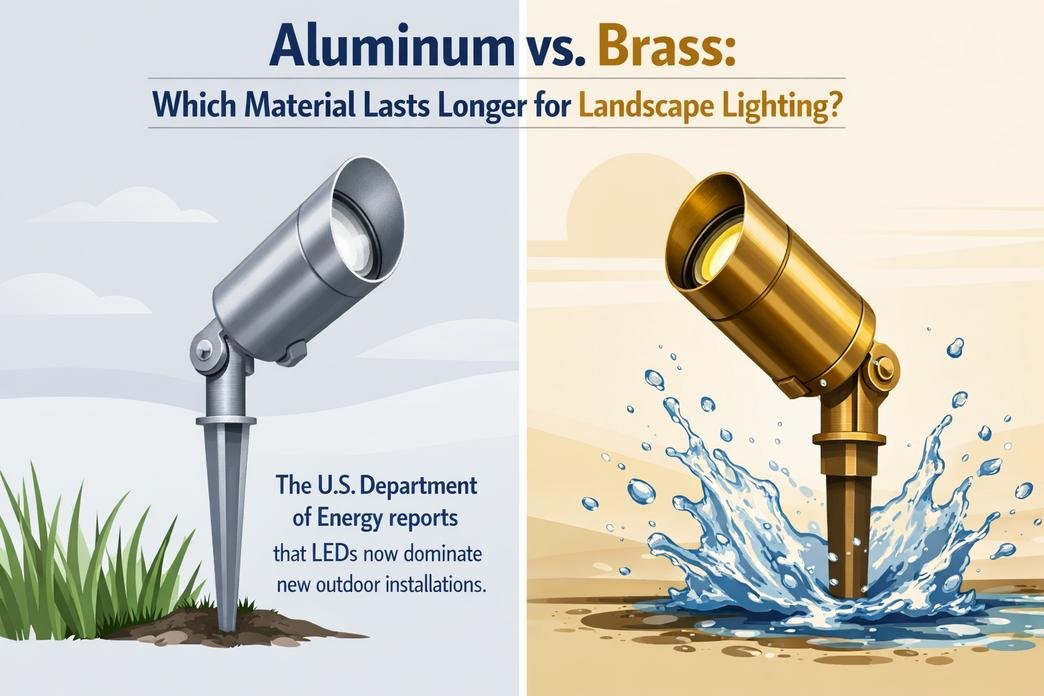
The U.S. Department of Energy reports that LEDs now dominate new outdoor installations due to long life and lower maintenance demands (DOE Solid-State Lighting Report, 2023). Long life only pays off if the housing survives the ride.
Aluminum is the nimble pickup—light, affordable, easy to install. Brass is the old-school cast-iron skillet—heavier, pricier, stubbornly durable. When soil, salt, and sprinkler spray go to work, material choice stops being theory and starts being money on the ground.
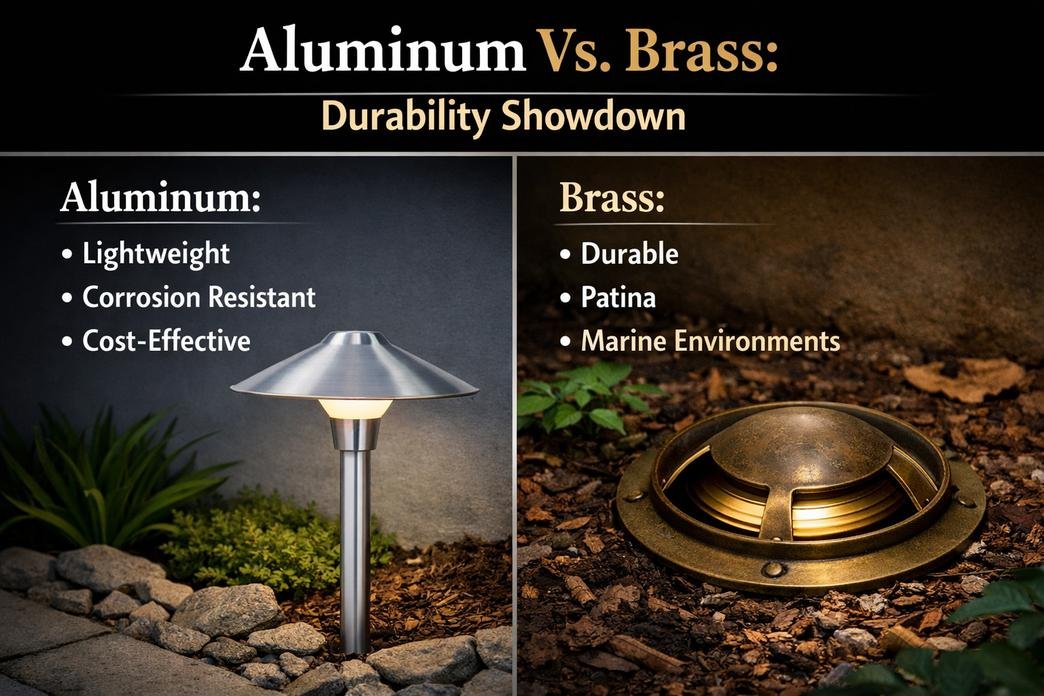
Aluminum Vs. Brass: Durability Showdown
Choosing materials for landscape and outdoor lighting is not just about looks. It affects corrosion control, heat flow, and how fixtures age in rain, soil, and salty air. For landscape lighting and outdoor lighting projects, aluminum and brass show up again and again for good reason.
Aluminum
When aluminum is used in landscape and outdoor lighting, performance often comes down to surface treatment and environment.
- Core material traits
- Lightweight body reduces load on mounting stakes and poles.
- Strong strength-to-weight ratio supports path lights and flood fixtures without bulky housings.
- Natural resistance to corrosion slows visible damage in humid climates.
- Surface protection systems
- Powder coating
- Seals the base metal.
- Shields against moisture-driven oxidation.
- Adds color stability for garden lighting layouts.
- Anodization
- Thickens the protective oxide layer.
- Improves scratch resistance for outdoor lighting in high-traffic zones.
- Thermal performance in lighting
- Efficient heat dissipation helps LEDs maintain output.
- Lower internal temperatures extend driver life in landscape and outdoor lighting installations.
In coastal landscape lighting, aluminum performs best when coatings stay intact. If the finish chips, salt can speed up oxidation. For budget-conscious outdoor lighting projects, though, aluminum keeps things practical and easy to install.
Brass
Brass brings a different attitude to landscape and outdoor lighting—heavier, tougher, and built to age with character.
- Material composition advantages
- High corrosion resistance in damp soil.
- Dense structure, often in heavy gauge form, resists impact from tools or foot traffic.
- Mechanical behavior
- Excellent malleability allows precise shaping of well lights.
- Reliable ductility reduces cracking under ground pressure.
- Environmental response
- Forms a natural patina over time.
- Surface darkens through controlled weathering.
- Protective layer slows further corrosion.
- Performs strongly in marine environments, where outdoor lighting fixtures face salt spray daily.
For landscape and outdoor lighting along driveways or commercial grounds, brass stands up to moisture and soil contact without relying on added coatings. It costs more upfront, yet in long-term outdoor lighting use, the durability often balances that investment.
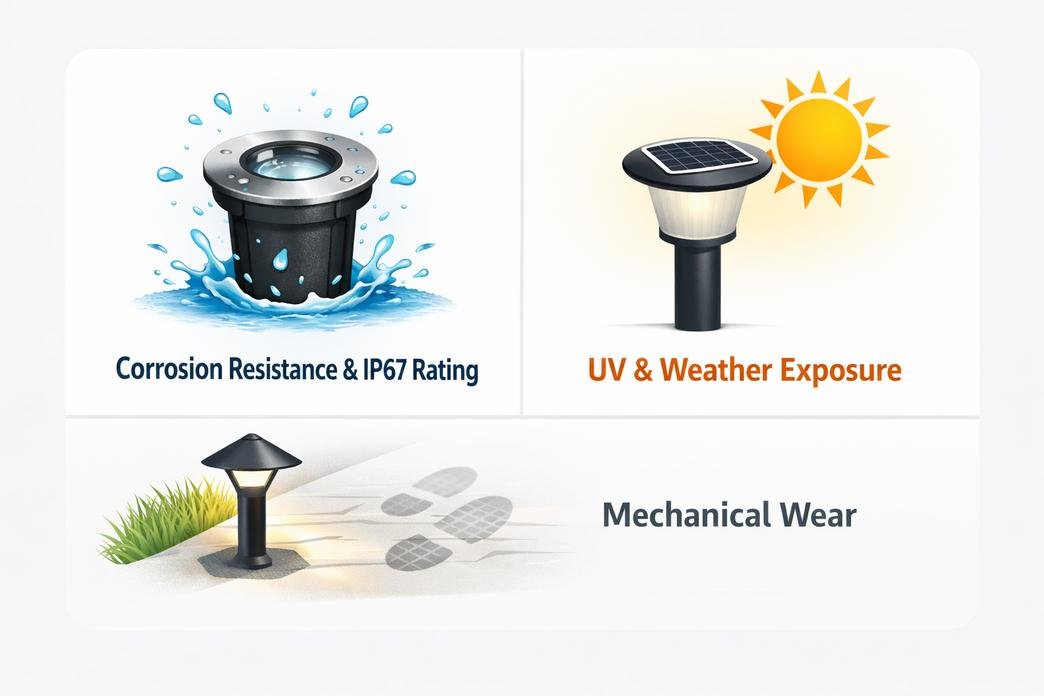
3 Factors Affecting Material Lifespan
Good landscape and outdoor lighting isn’t just about brightness; it’s about how long the gear survives outside. Rain, sun, foot traffic—these things don’t play nice. In landscape lighting, smart material choices keep fixtures solid for years. Here’s what really shapes durability in outdoor lighting systems.
Corrosion Resistance in IP67 Rated In-Ground Lights
For landscape and outdoor lighting installed at ground level, survival starts below the surface.
1) Protection Against Moisture
- Core risk: moisture and water ingress
- Standard reference: IP67 rating
- Result: Reduced material degradationa. Housing Design
- Fully sealed trim rings
- Silicone gaskets blocking corrosion triggersb. Material Selection
- 304/316 stainless steel for high resistance
- Brass for coastal soil
2) Installation Environment
- Public parks → irrigation overspray
- Driveways → standing water
- Pathways → compacted soil trapping moisture
In modern in-ground lights, even minor sealing flaws invite slow corrosion. MG Lighting applies sealed chambers and tested alloys so outdoor ground fixtures don’t quietly fail after one wet season.
UV and Weather Exposure on Solar Powered Bollard Lights
Solar fixtures live fully exposed in landscape and outdoor lighting layouts.
1) Environmental Stress
- Constant UV radiation
- Heavy weather exposure
- Seasonal heat swingsa. Surface Impact
- Material fading
- Hairline crackingb. Internal Impact
- Battery decline
- Photocell drift
2) Long-Term Environmental Impact
- Sun + rain cycles accelerate wear
- Plastic housings degrade faster without UV stabilizers
The U.S. Department of Energy noted in its 2024 Solid-State Lighting report that prolonged UV exposure significantly influences polymer fixture lifespan in exterior LED applications.
Quality solar powered bollard lights used in outdoor garden lighting rely on UV-stable coatings. MG Lighting integrates reinforced housings to keep color and structure intact under harsh sun.
Mechanical Wear in Low Voltage LED Path Lights
Foot traffic changes everything in landscape and outdoor lighting along walkways.
1) Physical Stress Factors
- Repeated abrasion
- Accidental impact
- Gradual material fatiguea. Fixture Body
- Die-cast aluminum reduces physical damage
- Bronze resists dentsb. Electrical Stability
- Secure low voltage connections
- Shielded wiring
2) High-Traffic Zones
- Commercial plazas
- Residential drive paths
- Public courtyards
Well-built LED path lights in outdoor pathway lighting need tight mounting and stable transformers. MG Lighting designs housings that handle daily bumps without loosening or cracking, keeping the full landscape and outdoor lighting system steady for the long haul.
Worried About Rust? Choose The Right Material
Outdoor spaces look amazing with well-planned landscape and outdoor lighting, but rust can quietly wreck the vibe. Moisture, soil chemistry, and salty air all mess with fixtures. Smart material choices keep your outdoor lighting system solid for years. Let’s break down how to protect your landscape and outdoor lighting without constant repairs.
Rust-Prone? Opt for Powder-Coated Aluminum Fixtures
When corrosion keeps showing up in your landscape and outdoor lighting, material science matters.
- Core material advantage
- Powder-Coated Aluminum Fixtures
- Protective powder layer seals raw metal
- Resists oxidation in rainy climates
- Reduces surface chipping
- Performance in outdoor lighting systems
- Path applications
- Stable for walkways and garden paths
- Area coverage
- Works well in open lawns
- Perimeter installs
- Handles sprinkler exposure
- Why contractors prefer it
- Lightweight housing
- Easy mounting adjustments
- Lower long-term upkeep costs
For homes upgrading landscape and outdoor lighting, this option balances price and durability. Brands like MG Lighting use advanced coating processes that help outdoor lighting fixtures hold up under heavy rain without turning flaky after one season.
High Humidity? Bronze Alloy Spotlights with Sealed Housing
Coastal air and sticky summers push landscape and outdoor lighting to the limit.
Here’s what makes Bronze Alloy Spotlights a smart call:
- Natural corrosion resistance
- Aging that forms a protective patina
- Strong structural density
Add Sealed Housing, and things get even better:
- Internal LED components stay dry.
- Gaskets block moisture intrusion.
- Wiring connections last longer.
Quick breakdown for humid zones:
- Garden accent lighting → steady beam control
- Driveway uplighting → reliable performance
- Waterfront properties → reduced salt damage
Outdoor lighting in high humidity needs tight sealing and solid alloys. That combo keeps your landscape and outdoor lighting sharp instead of streaked with corrosion stains.
Frequent Maintenance? IP67 Rated Brass Well Lights
If your outdoor lighting setup constantly needs repairs, rethink the fixture grade.
- Protection level
- IP67 Rated Brass Well Lights
- Dust-tight enclosure
- Handles temporary water immersion
- Shields internal drivers
- Ground installation factors
- Soil pressure
- Brass housing resists cracking
- Debris exposure
- Sealed lens keeps dirt out
- Foot traffic
- Strong top ring prevents warping
- Application fit
- Commercial grounds
- Public parks
- In-ground architectural lighting
For property managers tired of swapping damaged in-ground fixtures, upgrading the material changes everything. High-grade brass, used in advanced landscape and outdoor lighting solutions from MG Lighting, cuts repeat labor and keeps outdoor lighting systems running clean and bright year-round.
FAQs about Landscape And Outdoor Lighting
What materials are most durable for large-scale landscape and outdoor lighting projects?
Outdoor projects live or die by material choice. In busy pathways, gardens, and commercial grounds, durability protects both budget and safety.
1) Stainless steel – strong corrosion resistance, ideal for IP67 rated in-ground lights and well lights exposed to wet soil.
2) Brass & bronze – trusted for driveways and public parks; age gracefully while shielding LED components.
3) Powder-coated aluminum – lightweight yet weather-resistant, widely used in bollard lights, area lights, and spotlights.
A durable housing reduces failure under rain, irrigation, and foot traffic—keeping landscaping designs intact year after year.
Which fixture types are best for energy-efficient landscape and outdoor lighting installations?
Energy savings should feel effortless, not restrictive. The right fixture blends performance with comfort.
- Low voltage LED path lights connected to a transformer: safe for pathways and gardens, soft low glare output.
- Solar powered bollard lights with photocell control: no trenching, eco-friendly for public parks.
- LED floodlights with motion sensor: strong beam angle coverage for driveways and commercial grounds while cutting idle power.
Many systems now integrate wireless control or a smart lighting system, allowing dimmable schedules that respect dark sky compliant goals and wildlife friendly environments.
What does an IP67 rating mean for in-ground and well lights?
An IP67 rated fixture is built for direct burial and harsh soil conditions.
- Sealed against dust intrusion.
- Protected from temporary water immersion.
- Extends LED lifespan inside in-ground lights and well lights.
For landscaping near fountains, lawns, or heavy rain zones, this rating lowers maintenance stress and protects junction box connections from moisture damage.
How can buyers reduce maintenance and UV damage in bollard and path lights?
Sunlight and impact slowly weaken outdoor fixtures. Smart selection prevents constant repairs.
| Risk Factor | Recommended Solution | Typical Application |
|---|---|---|
| UV exposure | UV-stable, weather-resistant aluminum housing | Gardens, waterfront pathways |
| Moisture & soil | Stainless steel or bronze, IP67 rated base | Public parks, landscaping beds |
| Physical impact | Thick-walled bollard lights, secure junction box mounting | Driveways, commercial grounds |
Add LED over halogen for cooler operation and longer life. A carefully mounted path light with proper beam angle control not only survives harsh seasons—it keeps outdoor spaces inviting long after sunset.